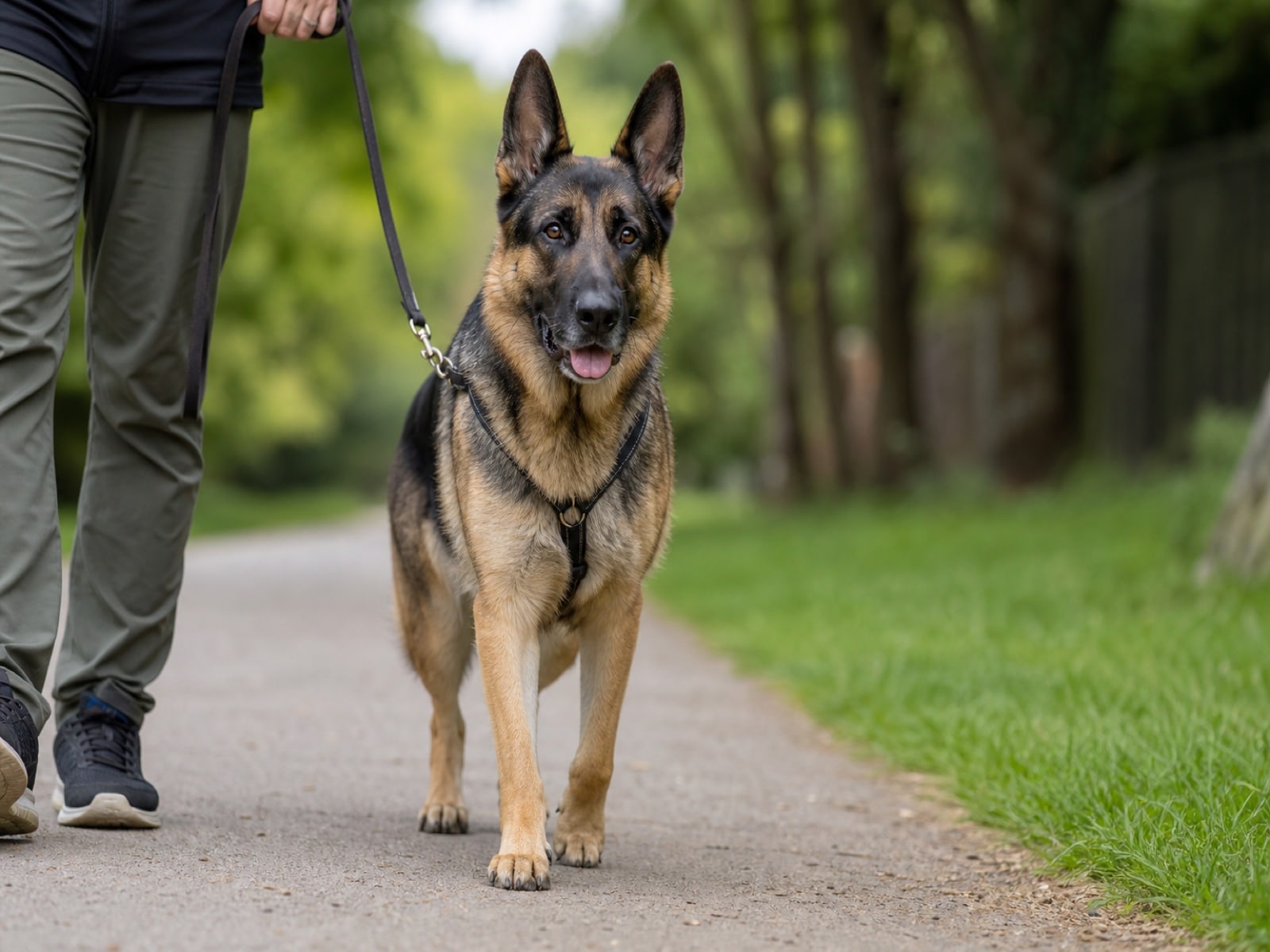
Amber came to us with Stormi, a dog struggling with anxiety alongside her obedience. Going out into the world was hard for both of them.
Stormi's case is the kind of thing the structured training system was built for. When a dog is anxious, the world is loud and unpredictable, and that anxiety bleeds into every command, every walk, every car ride. The first job is not to teach sit. The first job is to give the dog a clear language for what is right and what is not.
Building engagement first
Andrew runs every program on the same baseboard: clear, structured communication and a dog who knows what is expected. With Stormi, that meant slowing down, building up engagement (the dog's focus on her handler and willingness to work) before pushing on obedience. Engagement is the lever. Once a dog knows how to "learn to learn," everything else gets faster.
Proofing in the real world
From there, the work moved into proofing all the basics: sit, down, stay, come, heel on a loose leash, place. Each behavior taken from a quiet room into the parking lot, into the neighborhood, into the kind of distraction Stormi would actually face on a walk with Amber. That is the difference between a dog that knows the commands and a dog that performs them, every time, when it counts.
The outcome
By graduation, Amber had a different dog at the end of the leash. The transformation Amber described was less about a long list of new tricks and more about a fundamental shift: Stormi could leave the house again, and Amber could too.
Stormi came back a new dog. I can now finally take her out to places. I am forever grateful that I found High Caliber Working Dogs.